By Kuda Pembere
Cardiothoracic surgery teams from Egypt and Zimbabwe have wrapped up a third five-day mission in which they performed life-saving open heart surgeries on children, marking another milestone in efforts to strengthen local cardiac care.
The operations done at Parirenyatwa Group of Hospitals, ran from Monday to Friday, and this saw two children undergoing surgery each day, bringing the total number of procedures to 10.
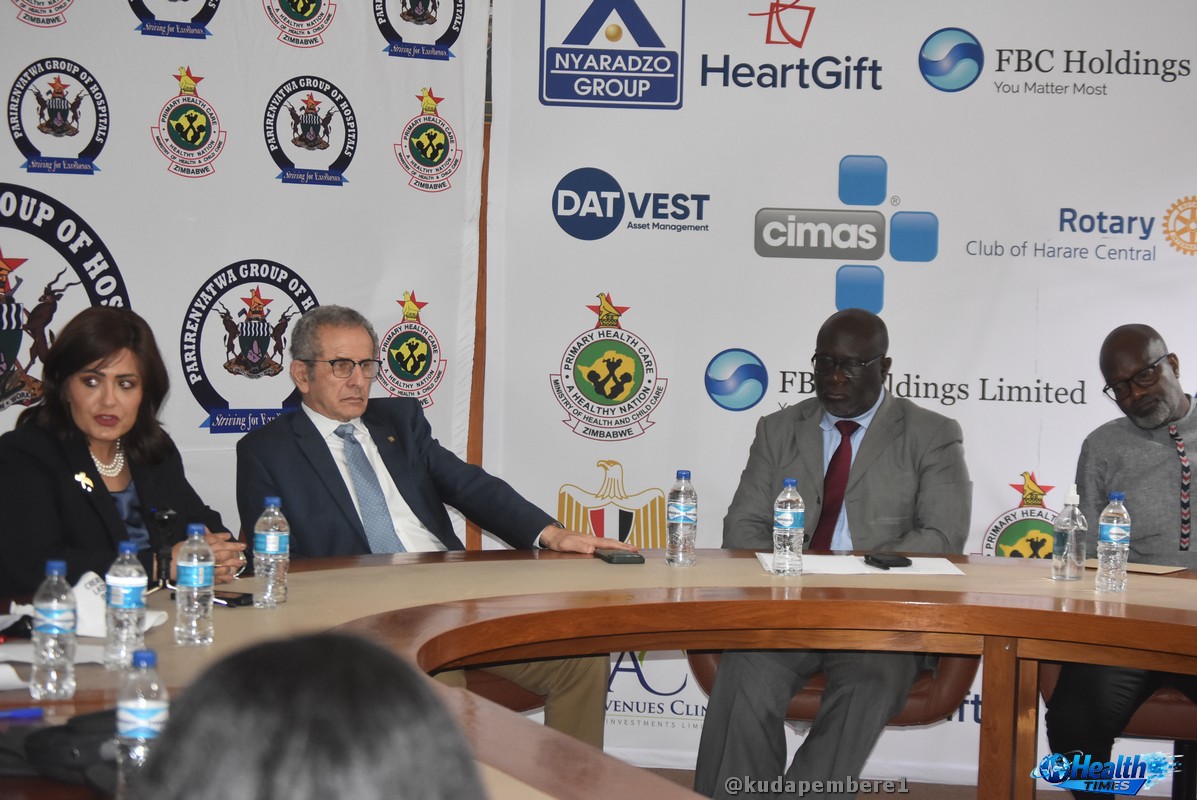
“So I’m happy to say we managed to operate on 10 patients, and all the surgeries were successful. The patients are now all in the Intensive Care Unit (ICU). More than half of them are already in the general ward,” Dr Simukai Machawira, Head of the Cardiothoracic Unit at Parirenyatwa told the media on Friday .
“The ones still in ICU are out of critical danger. They are breathing on their own and their hearts are functioning independently. So in that respect, it has been very successful. It’s unfortunate we could not reach the target of 11, but still, it’s a 10 out of 10, and I think that’s very good.”
Beyond the successful procedures, the impact of the programme is far-reaching, particularly for families who would otherwise have to seek costly treatment abroad.
Dr Machawira said the initiative has not only saved lives but also reduced the financial and emotional burden on families.
“In terms of impact, you can speak to the families and the patients themselves. Without surgery, many of these children would face repeated hospital admissions and miss school. When a child misses school, it often means a parent also misses work,” he said.
“So the ripple effects are significant. Caring for one sick child requires a lot of time and attention, often at the expense of other children in the family. It is difficult to quantify, but the impact is huge.”
He added that the intensive surgical camp had also shifted the mindset of local medical teams regarding what is possible.
“We usually perform one cardiac surgery a week. During this camp, we were doing up to three surgeries a day. It changes the perspective of the whole team in terms of what we can deliver,” he said.
“It is now our goal to establish an independent cardiothoracic ICU so that we can consistently perform at least two or more surgeries a day on our own.”
Egyptian Ambassador to Zimbabwe, Dr Maha Seag El-Din, said the missions are designed to go beyond immediate care and build long-term capacity in Zimbabwe’s health sector.
“These missions are an opportunity for knowledge transfer. They contribute to the health sector in Zimbabwe and reflect Egypt’s support for development efforts, including the National Development Strategy 2, which we stand ready to support,” she said.
Leading the Egyptian surgical team, Professor Hesham Shawky said the ultimate goal is to establish a sustainable paediatric cardiac surgery programme in Zimbabwe.
“Targeting three cases a day is possible, but the key is to close the gap between our visits. Our camps are months apart, and during that time, the local team must continue operating,” he said.
“This is how you build a sustainable programme. It must be based on continuous improvement. Dr Machawira and his team have the skills, the knowledge, and now the equipment, including a new heart-lung machine.”
He stressed that the focus should shift from short-term missions to long-term systems.
“We are aiming for sustainability, not just camps. From the beginning, our goal has been to establish a lasting paediatric cardiac surgery programme in Zimbabwe,” he said.
Professor Shawky noted that paediatric cardiac services remain underdeveloped across much of the region, presenting an opportunity for Zimbabwe to take a leadership role.
“In this region, including Zimbabwe and Zambia, these services are still limited. I hope Zimbabwe can take the lead and become a regional hub for paediatric cardiac care in Africa,” he said.
Parents of the children who underwent surgery welcomed the programme, with some saying it spared them costs of up to US$15,000 that they would have incurred seeking treatment in countries such as India.