By Kudakwashe Pembere
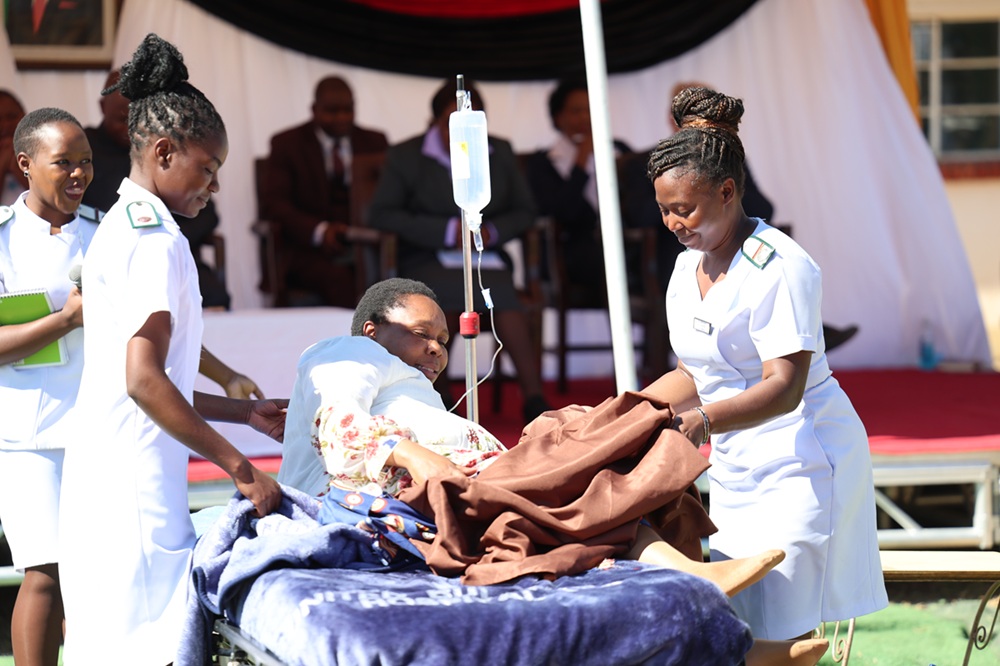
On March 1, 2024, donning a purple silk night gown, Tatenda Nyakutya is admitted in Ward B5 for females as she awaits to see her 17-year-old child whom she last saw about a week prior her surgery. Despite the pots surgery pain, Tatenda’s sense of humor gets the best of her as she finds time to crack one or two jokes with her relatives.
“So in 2022, I collapsed and they rushed me to Nyanga District Hospital,” says Tatenda as she shuffles through a medicine bag containing some pain relievers amongst other medicines and lets a minor cough.
Three days earlier, the surgery day, Tatenda was uncertain whether she would emerge from the theater room alive. Tatenda had a thymectomy removing a tumor of the thymic gland, using a Video Assisted Thoracoscopy Surgery (VATS).
Hailing from Nyanga, Tatenda for 10 years was bed-ridden, in and out of hospitals without the ability to do chores like cooking and cleaning. She only managed to prepare her bed but post this successful operation she is rearing to do these chores.
Tatenda would get asthma and heart conditions treatments until 2022 when she was diagnosed as having a myasthenia gravis, a chronic condition resulting in voluntary muscle weakening. Voluntary muscles are necessary for breathing, eating, and making facial movements. They contract to move the arms and legs.
When i got sick, i was referred to Victoria Chitepo Provincial Hospital. Then they referred me to All-Souls Mission stating they specialize in heart conditions. The doctors’ diagnosis was that the heart had a problem from somewhere else and they referred me to a cardiologist in Harare named Dr Fana. Dr Fana referred me to endocrinologists who after hormone tests did myasthenia gravis tests which tested positive. That was in July 2022.
“They suggested a CT scan but I misplaced the results but I guess it was by God’s grace or favor somehow, that last year, we did another CT scan which revealed that I had a thymus gland tumor. It is responsible for building up an unborn baby’s immune system and shrinks when being a teenager but mine was growing with 40 mm by 44 mm by 13 mm as dimensions,” she said.
The doctor’s recommendation that a surgery was necessary to avoid fatal complications, sent shivers down her spine. In her own words, her faith in the almighty was shaken for once.
However, the pre-surgery counselling sessions she had with Zimbabwe’s only female cardiothoracic surgeon, Dr Kudzai Kanyepi soothed a bit. This however did not totally eliminate her phobia as she walked out twice on the cardiothoracic surgeon.
“I showed the doctors the results and they advised I undergo an operation. The first day they told me about this operation, I didn’t take it to my head then after a while I was referred to Dr Kanyepi whom I told I was against the operation for fear of dying.
“She then convinced me, and I credit her smile which changed my mind to brave the operation. Had I not met her, I wouldn’t have undergone the operation,” she says. “It is said a thankless heart is akin to witchcraft. I may not have enough words or anything to show my deep gratitude but I would like to thank Dr Kanyepi and Dr Tanaka and the nurses. This has been the best experience ever. I would hear people saying Parirenyatwa is bad, but my experiences here have been good. And I really thank the Hospital staff for taking care of me.”
The thought of uncertainty and death gripped her the most. Her greatest fear was dying and leaving behind her her child and parents back in Nyanga. A WhatsApp group with other myasthenia gravis patients alongside Google search, helped keeping her mind calm.
“Counselling helped me accept the situation and understand the importance of the operation. Counselling really helped me. Nowadays, thanks to Google, you can research further information on a topic.
“Upon hearing an operation was necessary, I wouldn’t want to lie that it was the best news ever. At first, I had mixed feelings, feeling numb, with my mind going blank. I told my parents that the doctors were mad to suggest an operation. To the operating theatre, I tried well in masking the fear with laughter. Growing up were the old wives’ tales that operations kill. So before operation, I did not hesitate to ask any question I had.
“The other thing that provided comfort to me was joined a WhatsApp group for myasthenia gravis patients. Although they are few in Zimbabwe, there are many outside the country. So, they would tell how successful they had a thymectomy thirty years ago, others 25 years ago and that gave me courage to go for the surgery.
“I was advised that an operation was necessary was necessary to avoid a myasthenia crisis where I would not swallow food, nor speak nor breathe well implying I would be like a dead person, a vegetable as it were. That is why I opted for the operation. Other friends and pastors encouraged me and prayed for me. I remember making people laugh after remarking that I needed a prayer. It was because of fear,” Tatenda says.
She also encouraged people to desist from demeaning public hospitals like Parirenyatwa as
contrary to some beliefs, she found her own salvation there.
Insofar as males are regarded as more surgery-phobic than females, Ranga (not real name) had no option but to take the VATS an opportunity to get rid of his problem of a destroyed lung from tuberculosis. An array of tests were done but nothing was found. Recurring severe TB illnesses led to him getting referred to Pari, get tests done resulting in the infection in his left lung removed.
Zimbabwe held a masterclass training workshop for surgeons in VATS. Dr Kudzai said the training not only enhanced their skills as surgeons but nurses as well.
“As we were doing before, we were doing some surgeries minimally invasive, but we want to take surgeries forward. So this course aims to equip not just the surgeons, but also the nursing teams and the hospitals to be able to undertake this more advanced technique.
“And also going forward, this will be part of our armatarium that we use in cardiothoracics at Parirenyatwa doing these techniques minimally invasive,” she said.
The Head of Parirenyatwa cardiothoracic department Dr Simukai Machawire said the workshop offered them a chance to refine their thoracic surgery skills.
Dr Machawire said they are hopeful they will be doing robotic surgery for the thoracic cavity.
“So we want to use this modified technique of a video-assisted thoracic Surgery where instead of having three ports you will be having one port which we call uniportal thoracic surgery.
“And we are sure this will be a success as we have a team with extensive experience and hopefully this will be our first time.