By Michael Gwarisa
Zimbabwe is experiencing a demographic shift in terms of fertility rate, in line with global trends, as more people struggle to achieve their reproductive goals. According to the 2024 State of the World Population (SWP) report by UNFPA, the world is undergoing a fertility crisis where individuals are increasingly unable to have the number of children they want, when they want, or with whom they want.
Back home, the country’s Total Fertility Rate (TFR) has seen a steady decline from 4.3 children per woman in 1994 to 3.8 in 2005–2006. The most recent 2023–2024 Zimbabwe Demographic and Health Survey (ZDHS) shows a slight rebound to 3.9, but this still represents a long-term trend of declining fertility. While Zimbabwe remains above the population replacement level of 2.1, the figures reflect a changing social landscape shaped by economic hardship, rising infertility, and evolving attitudes toward marriage and childbearing.
The implications are far-reaching. Experts warn that if these trends continue without appropriate intervention, Zimbabwe risks narrowing its future labor force, losing out on the demographic dividend, and failing to support individuals’ basic reproductive rights.
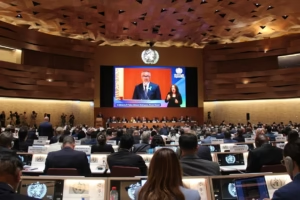
Speaking during the launch of the 2025 SWP report, Health and Child Care Minister, Dr Douglas Mombeshora said fertility decisions are being shaped by a complex web of challenges.
Our journey is far from complete. The report reveals that many young people wish to start families but are constrained by structural, cultural and economic challenges,” said Dr Mombeshora.
“Zimbabwe has a uniquely youthful population with 66 percent under the age of 30. This presents immense potential for development, but unmet need for contraception and gender-based violence remain significant barriers, particularly for young people and marginalised communities.”
Dr Mombeshora said the government remains committed to upholding reproductive rights, in line with the International Conference on Population and Development (ICPD) principles. “We believe in children by choice, not by chance,” he said. “We are proud of the progress made, including a historic decline in the maternal mortality ratio from 651 per 100,000 live births in 2015 to 212 today, and increased uptake of modern contraceptives among women.”

Findings presented by Dr Edwin Mpeta, UNFPA Zimbabwe’s Programme Specialist for Reproductive Health, painted a broader picture of global trends. He said the global fertility rate has declined from an average of 5 children per woman in the 1950s to an expected 2.1 by 2050. Population growth is expected to peak by 2085, after which it will begin to decline.
Dr Mpeta noted that while many people across countries still want to have children, multiple barriers prevent them from doing so. He cited data from a 14-country study commissioned by UNFPA and the UK Foreign Office that showed over 40 percent of people aged 50 had not achieved their desired family size. Among younger respondents, 20 percent do not expect to meet their fertility aspirations and 45 percent are uncertain.
“One in four were unable to conceive when they wanted a child, and one in three had an unintended pregnancy. Around 15 percent experienced both,” he said. “This shows the crisis is not one of overpopulation or underpopulation, but rather a crisis of unmet reproductive goals.”
He highlighted the economy as the leading barrier, with 40 percent of respondents citing financial reasons for not having the number of children they wanted. Other obstacles included infertility, chronic illness, political instability, and lack of a suitable partner.
“In Zimbabwe, infertility services are almost nonexistent in the public sector and prohibitively expensive in private facilities. This creates a paradox. We are among the best in the region for family planning, yet we are doing poorly on infertility care,” said Dr Mpeta. He added that policies remain fragmented and underfunded, with limited youth support and minimal investment in fertility-related research.
What’s Being Done to Address the Crisis
UNFPA Zimbabwe Country Representative Miranda Tabifore said efforts are underway to address the multifaceted barriers through the agency’s integrated Eight-Country Programme.
“The programme focuses on four outcomes: zero maternal deaths, zero unmet need for family planning, zero gender-based violence, and zero new HIV infections. These are being addressed within a framework that targets adolescents and young people through a combination of health, education, and economic empowerment initiatives,” said Tabifore.
She added that the Ministry of Finance is coordinating the programme to ensure alignment with national priorities. Implementing partners, including the Zimbabwe National Family Planning Council (ZNFPC), are working on the ground to raise awareness and deliver services, especially to young people.
ZNFPC’s Chief Executive Officer (CEO), Farai Machinga said Zimbabwe is also leveraging advocacy and policy engagement to drive change. “We are working with parliamentarians to increase domestic financing and policy support. The ‘Not In My Village’ campaign has been instrumental in reducing teenage pregnancy and child marriage,” he said.
Machinga noted that comprehensive sexuality education is being rolled out to equip young people with accurate information. However, he emphasized the need for more investment in fertility research and services. “We must ensure our policies and resources support the full spectrum of reproductive health, including infertility care,” he said.
Senior Health Advisor at the British Embassy in Harare, Tessa Mattholie, echoed the urgency of strengthening reproductive autonomy.
“This year’s report brings a powerful and urgent message. The real crisis is not about numbers but about the ability of individuals to make informed decisions about if, when, and with whom to have children,” she said.