
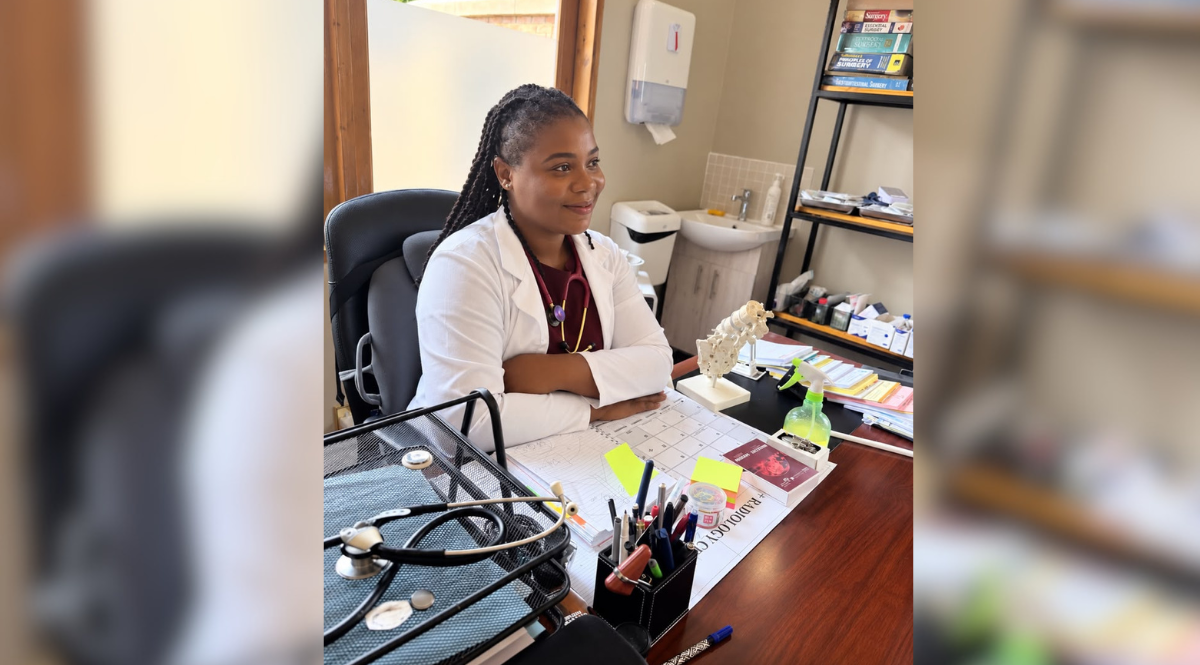
By Michael Gwarisa
For Dr Neddy Fungisai Makonza, the journey to becoming an orthopaedic surgeon began long before she entered a medical school or stepped into an operating theatre. It began in childhood, when her late mother would call her “Doctor Neddy”, a name that would eventually become a reality after years of study, specialist training and personal sacrifice.
Makonza completed her specialist training in Orthopaedic Surgery in December 2025 through the College of Surgeons of East, Central and Southern Africa (COSECSA), with her specialist examinations and graduation held in Burundi.
She is now described as Zimbabwe’s fourth female orthopaedic surgeon and the first woman to enter the specialty in the Midlands Province, milestones she says should ultimately be verified by the relevant professional bodies.
For Makonza, however, becoming the first female orthopaedic surgeon in the Midlands carries a significance that extends beyond a professional title.
She sees it as an opportunity to contribute to the decentralisation of specialist healthcare in a province where patients can face long journeys to access specialised treatment.
“A large proportion of specialist services are concentrated in major cities, particularly Harare,” Makonza says. “Patients from provinces such as the Midlands may have to travel long distances to access certain specialist services.”
For patients and their families, she says, such journeys can bring additional costs for transport and accommodation, as well as time away from work.
The challenge is particularly relevant in orthopaedic care, where patients may require specialised treatment following trauma, fractures and other conditions affecting mobility and function.
Makonza hopes her presence as a specialist in the Midlands will contribute to strengthening services closer to where patients live.
“Being the first female orthopaedic surgeon in the Midlands therefore means more to me than a personal milestone,” she says. “I would like it to contribute to the development of specialist healthcare outside the major cities.”
Her path to the operating theatre, however, was not straightforward.
Growing up in a low-income family, Makonza says she once struggled to imagine that university was within her reach. Becoming a doctor, let alone specialising in orthopaedic surgery, appeared far beyond what she believed she could achieve.
Her mother remained an important source of inspiration, although she did not live to see her daughter achieve the qualification she had once imagined for her.
“When I eventually became a doctor, one of the things I wished for was to be able to share that moment with her,” Makonza says.
Her decision to pursue orthopaedic surgery also came after initially considering another demanding specialty.
Neurosurgery was her first choice, but an elective attachment in India made her reconsider. She had tremendous respect for neurosurgeons, she says, but realised that the very long operating hours were not what she wanted for herself.
Orthopaedic surgery offered a different attraction.
During medical school, she encountered orthopaedic surgeons who made the specialty appear approachable and enjoyable to learn. She was also drawn to the tangible changes that orthopaedic treatment can make in patients’ lives, from repairing fractures and restoring function to performing joint replacements and helping people regain mobility and independence.
During her internship, she was particularly influenced by Mr Brian Paketh, who at the time was the only orthopaedic surgeon in the Midlands. That experience made her recognise the province’s need for more specialists.
“I realised just how much the province needed more orthopaedic surgeons,” she says. “That made me think that perhaps I could be part of the solution.”
Becoming part of that solution required years of demanding training. Orthopaedic surgery involves trauma and emergencies, requiring surgeons to remain physically present for long periods and respond when patients sustain serious injuries.
For Makonza, training in the Midlands also meant confronting the province’s particular trauma burden. Mining-related injuries and road traffic accidents contribute significantly to the demand for orthopaedic services, she says.
The training came with personal costs as well.
There were holidays she could not attend and family gatherings she missed because of work and studying. Balancing family, work and specialist training was difficult, she says, and she credits her family for understanding her absence and continuing to support her.
There were also moments when she questioned whether she was capable of completing the programme. In the early stages of specialist training, Makonza says she would sometimes open her textbooks and feel overwhelmed by the amount of new information she was expected to master.
There were moments when she wondered whether she was suited to specialisation and considered quitting. Her mentors encouraged her to continue, reminding her that competence develops through repeated study and practice.
“Sometimes you are not incapable, you are simply still learning,” she says.
That experience has become part of how she understands the journey into specialist medicine. For women in surgery, the demands can be even more complicated. Makonza says surgical training often coincides with the prime reproductive years for women, while women may also carry responsibilities as mothers, wives, daughters and daughters-in-law.
She experienced those competing demands herself, becoming pregnant while undergoing specialist training. Pregnancy brought physical and emotional challenges while she continued working and studying. After giving birth, she had to navigate breastfeeding, long theatre hours and returning home late while raising children.
There were moments when she questioned whether she was being a good mother because she was pursuing education and a demanding career. But she rejects the idea that women should have to choose between motherhood and professional ambition.
“I do not think the answer should be for women to give up either motherhood or their careers,” she says.
“I do not want the next generation of women to have to choose between motherhood and becoming excellent surgeons. I want them to have better systems and support than I had.”
Her experience has also exposed her to gender and age-related assumptions. In the early stages of her career, she says she was sometimes judged because she was both young and female, making it difficult to be immediately accepted or taken seriously.
Her response was to allow her work to demonstrate her abilities. But she says orthopaedic surgery should not be reduced to physical strength, an assumption that can sometimes discourage women from considering the specialty. Good orthopaedic surgery requires knowledge, surgical technique, judgement, planning, precision, resilience, teamwork and decision-making under pressure.
For Makonza, support has been central to reaching this point. Her extended family helped provide opportunities during her childhood and education. At university, she credits the National University of Science and Technology administration, lecturers and mentors, as well as the NUST Student Work Programme, which enabled students to work and earn money to contribute towards their education and living expenses.
During specialist training, orthopaedic surgeons, colleagues and mentors contributed to her development, while the Zimbabwe Orthopaedic Association provided training programmes, mentorship initiatives and lecture series.
Financial support also made a significant difference.
Through the AO Women’s Scholarship, Makonza received assistance with examination fees, flights, accommodation and a monthly stipend during her specialist training. She believes such initiatives can help address financial barriers that may discourage women from entering surgical specialties.
Her ambitions now extend well beyond becoming the first female orthopaedic surgeon in the Midlands. Makonza is interested in several areas, including Sports Medicine, Foot and Ankle Surgery, Hand and Upper Limb Surgery and Arthroplasty. Her particular ambition is to specialise in Hand and Upper Limb Surgery and eventually become Zimbabwe’s first female hand surgeon. She also wants to establish a Hand Unit in Zimbabwe where patients can access specialised treatment while young surgeons receive training.
For her, further qualifications are not the ultimate goal. She wants to use specialised knowledge to build services that can treat patients, train young surgeons and eventually develop into centres of excellence.
As Zimbabwe gradually sees more women enter orthopaedic surgery, Makonza believes representation can influence what younger girls consider possible. The fact that three more women are expected to sit their specialist examinations in December, she says, is an encouraging indication that more women are beginning to see orthopaedic surgery as a career open to them.
She wants more mentorship programmes, scholarships and training opportunities for women, alongside systems that recognise the challenges women face during specialist training and throughout their careers.
Her own achievement, therefore, is not something she wants to keep as a personal milestone.
“I do not want my achievement to simply be that I became the first,” she says. “I want it to be that I was the first who helped make it easier for others to follow.”
For the girl who once heard her mother call her “Doctor Neddy”, the operating theatre represents more than the destination of a long educational journey. It is also a place from which she hopes other women will find a path into medicine, surgery and specialist care.
Her message to them is straightforward: surgery is not a profession reserved for men, and being a woman does not make someone less capable of becoming a surgeon.
“If you want it, work for it,” she says. “And when you get there, remember to leave the door open for the girl coming behind you.”