
By Kuda Pembere
At a time when Zimbabwe’s public debt has reached US$23.7 billion, the AIDS Healthcare Foundation (AHF) has urged the government to join the proposed Borrowers Forum, bringing together debt-distressed countries to amplify their collective voice in efforts to address the global debt crisis.
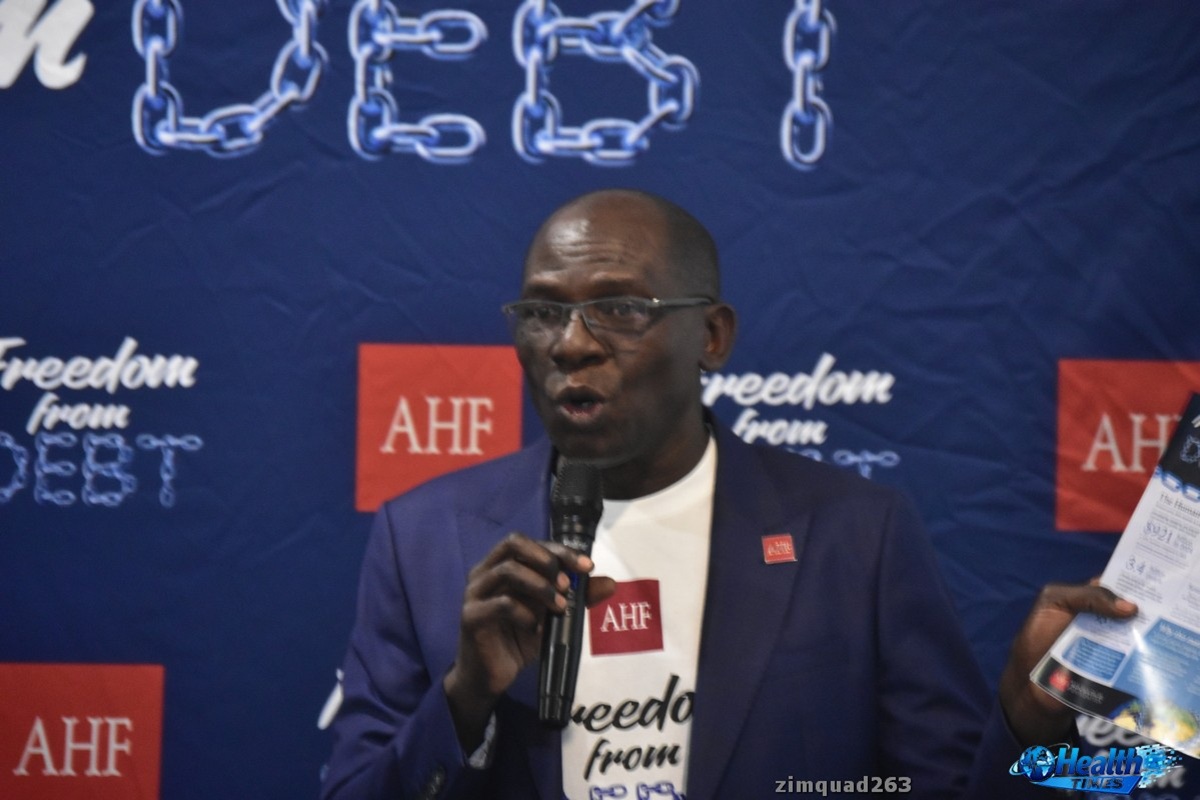
AHF Zimbabwe Country Director Dr Ernest Chikwati made the call at a Freedom from Debt campaign press conference in Harare, saying the campaign seeks to promote strategies for reducing the impact of debt on public services.
Chikwati said AHF was concerned about the effect of debt not only on healthcare but also on other essential social services.
“As an organisation, AIDS Healthcare Foundation has assessed the effect of debt not just on the health sector, but also on other social services. We realise that most governments, not just the Government of Zimbabwe, struggle to repay debt, but other social responsibilities are affected,” he said.
He said AHF was therefore advocating for governments to join the Borrowers Forum, an initiative discussed at the Fourth International Conference on Financing for Development in Seville, Spain, and subsequently amplified during South Africa’s G20 presidency.
“The advantage of having a Borrowers Forum is that you amplify your voices. You are better heard when you are united as a group,” Chikwati said.
“So we are pushing for governments to join that Borrowers Forum so that their voices are amplified.”
Chikwati said AHF was also calling for automatic, interest-free debt-service pauses during crises such as public health emergencies and climate disasters.
“We are also pushing for the idea where we have pauses in terms of interest charges on the debt. Whenever there is a crisis, like COVID-19, there should be a pause in terms of interest charges on our debt,” he said.
AHF is also advocating for a levy on artificial intelligence companies, with part of the revenue generated by the sector directed towards debt relief.
“We are pushing for that AI levy. Part of the income coming from AI businesses should be directed towards debt relief or debt repayment.
“Most of these AI companies are getting money from Africa and the Global South. So, at least if you can get one percent of their revenue going towards debt relief, it will help a lot. That is what we are really pushing for,” Chikwati said.
He said AHF was working with the government to encourage Zimbabwe to join the Borrowers Forum and strengthen its position in negotiations over debt repayment.
“We are working with and supporting the government to say, let’s get Zimbabwe to join the Borrowers Forum so that we amplify our voice when we are negotiating for debt repayment,” he said.
Senior economist at Africa Economic Development Strategies (AEDS), Dr Ticahona Zivengwa, said Zimbabwe remained in debt distress, with the country’s debt burden having been driven by macroeconomic instability dating back to the late 1990s and the hyperinflationary period of the 2000s.
Zivengwa said Zimbabwe’s total debt stood at US$23.7 billion as of June 2026.
Of this, US$11.7 billion was external debt, largely comprising arrears and penalties, while domestic debt stood at about US$10 billion, driven mainly by government securities issued to finance budget deficits.
“For the health sector, both channels squeeze the same pool of resources needed for medicines, equipment and infrastructure,” Zivengwa said.
He said between 2022 and 2024, Ministries, Departments and Agencies (MDAs) accumulated US$1.7 billion in domestic debt without the required approvals.
According to Zivengwa, the Ministry of Finance attributed this to transactions outside approved systems, weak controls, over-contracting and misalignment between budgets and cash releases.
Against this backdrop, Zivengwa said the Ministry of Health had, by June 2026, received and utilised 33 percent of its allocated budget, well below the 50 percent mark expected halfway through the year.
He said the ministry could reach about 50 percent budget utilisation by year-end, although achieving full utilisation would be difficult because of resource constraints and administrative delays.
“Going towards year-end, it is possible to hit 50 percent. Traditionally, we have managed to do so, sometimes going slightly above 50 percent. However, it may be difficult depending on the amount of resources available,” Zivengwa said.
He said low budget utilisation was also linked to delays in ministries and government departments submitting requisitions that meet Treasury requirements.
“Part of the problem with low disbursements in some ministries has to do with the processes involved in raising requisitions from Treasury. Some ministries, departments and agencies do not comply with the requirements, and as a result, their requests are not approved.
“There are procedures that have to be followed and documentation that must be submitted to justify the expenditure. Some ministries and agencies take time to put the required documentation together, which contributes to delays,” he said.
Zivengwa said resource availability was another factor affecting the pace of government disbursements, as Treasury expenditure was largely dependent on revenue collected by the Zimbabwe Revenue Authority (ZIMRA).
“The government plans its expenditure based on the revenue it expects to collect. If the expected revenue comes in late, it also delays Treasury disbursements to ministries.
“That is why there are quarterly payment periods. Revenue has to be remitted through ZIMRA, and when payments are delayed or taxpayers default, ZIMRA has to follow up, which can further affect the availability of funds,” he said.
Zivengwa said ministries could not simply carry forward unspent allocations into the following year.
“If you fail to reach the 50 percent mark, you also need to understand what happens. You cannot roll over that expenditure into the next year.
“For example, if by December 31 you have spent only 50 percent of your allocation, when January comes, the minister can redirect expenditure to other areas because the ministry failed to spend during the designated periods. That is how the government system works,” he said.