By Kuda Pembere
HARARE Institute of Public Health (HIPH) graduates have been challenged to turn their qualifications into practical solutions that improve community health and strengthen Zimbabwe’s healthcare system.
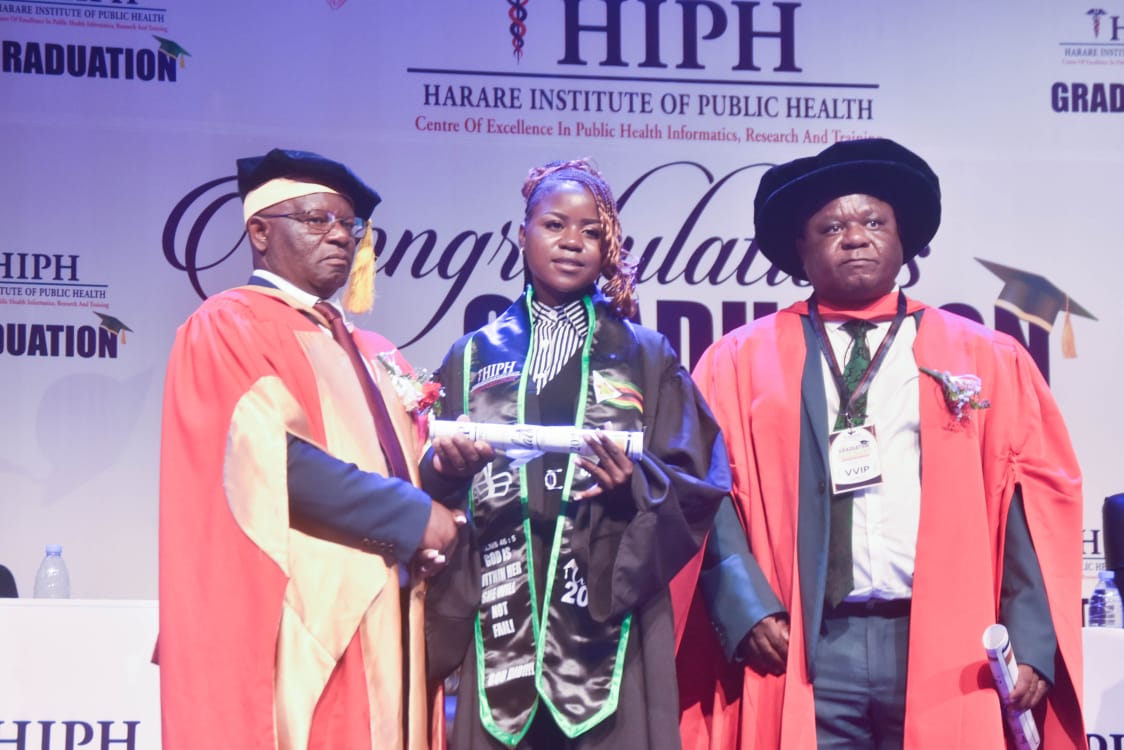
More than 700 students graduated from HIPH on Friday, including 15 students from Botswana’s Botlhale Institute of Public Health, after completing programmes in public health, nursing, pharmacy, health technology and other health-related fields.
Secretary for Institutions Engineer Tafadzwa Mudondo, who represented Higher and Tertiary Education, Innovation, Science and Technology Development Minister Ambassador Frederick Shava at the graduation ceremony, said the Class of 2026 demonstrated progress towards key National Development Strategy 2 (NDS2) targets.
In a speech delivered on his behalf, Shava said the graduates represented an important investment in Zimbabwe’s human capital and public health system.
“First, the development of competent human capital. The Class of 2026 has been assessed, examined, and found competent to serve our nation and communities,” he said.
Shava said the graduates had also been equipped to contribute to disease prevention and health promotion, while incorporating indigenous knowledge systems into health practice.
He challenged the graduates to uphold professional ethics and shun corruption, negligence and discrimination in their workplaces.
“The health professions are built on public trust. The communities you serve will depend upon your knowledge, competence, integrity and compassion,” Shava said.
“Reject corruption, negligence, discrimination, and the misuse of institutional resources. Protect the dignity and confidentiality of every person who seeks your assistance.”
He urged the graduates to continue upgrading their skills as healthcare and technology continue to evolve.
“Above all, remember that behind every health record or statistic is a human being, a family, and a community deserving of respect and quality service,” he said.
Shava also challenged HIPH lecturers and administrators to maintain academic standards as the institution expands.
“Growth must always be accompanied by quality, accountability and sound governance. Institutional expansion should never compromise academic standards,” he said.
HIPH chair Professor Simon Mukwembi said the institution had produced about 2,300 graduates over the past five years, with approximately 68 percent now working in hospitals, clinics, pharmacies, laboratories, non-governmental organisations, community health programmes and healthcare administration establishments in Zimbabwe and the region.
“Over the past five graduation cycles, the Institute has produced an estimated 2 300 graduates across its Schools of Public Health, Pharmacy, Nursing, Health Technology and Business and Healthcare Management,” Mukwembi said.
He said the graduates were contributing to disease prevention, health promotion, pharmaceutical services, diagnostics, research, nursing care and health-system administration.
“Another important milestone has been the growth of our academic programmes. From a modest portfolio during our formative years, the HIPH now offers more than 18 programmes at certificate, diploma and higher-diploma levels,” Mukwembi said.
He added that enrolment had increased by approximately 45 percent over the past three years, reflecting growing demand for specialised health training.
For graduate Chipo Taim, who qualified as a dispensary assistant, the journey to graduation was difficult but ultimately rewarding.
“It was hard, but thank God I made it,” she said.