By Michael Gwarisa
Africa is preparing to write a new chapter in its public health story—one defined less by dependency and vulnerability and increasingly by African leadership, science, innovation and the determination to take ownership of the continent’s health future.
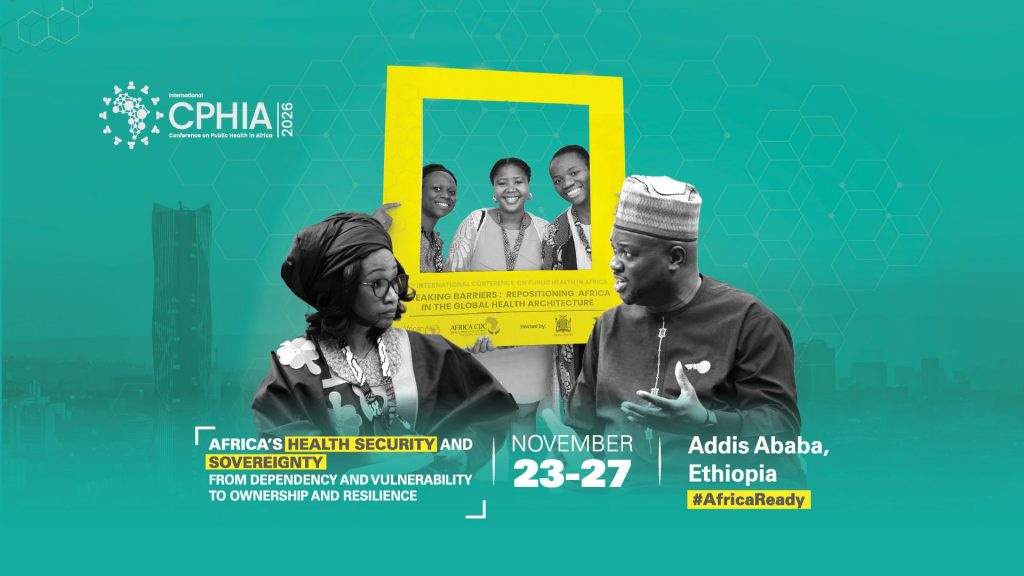
That ambition will take centre stage when the 5th International Conference on Public Health in Africa (CPHIA 2026) convenes from 23 to 27 November 2026, bringing together political leaders, scientists, public health practitioners, communities, young people, innovators, civil society and the private sector.
Convened by Africa Centres for Disease Control and Prevention (Africa CDC), the conference comes at a pivotal moment for a continent navigating disease outbreaks, public health emergencies, tightening health financing, climate pressures and persistent gaps in access to essential health services.
But alongside these challenges, another story is emerging: stronger African institutions, expanding scientific research, growing local manufacturing capacity and a new generation of public health leaders determined to ensure Africa plays a greater role in defining the solutions to its own health challenges.
Under the theme, “Africa’s Health Security and Sovereignty: Transformation from Health Dependency and Vulnerability to Ownership and Resilience,” CPHIA 2026 will explore how the continent can translate that ambition into stronger systems, sustainable investments and the capabilities needed to protect its people.
Ready to Lead. Ready to Respond. Ready to Protect. Ready to Prevent.
That is the message Africa CDC is putting at the heart of the road to CPHIA 2026.
Africa’s Public Health Future
Africa CDC Director General, Dr Jean Kaseya, said the conference represents an opportunity to bring together the institutions, knowledge and capabilities required for Africa to take greater ownership of its health security.
“Africa is defining the public health future it wants and building the institutions, knowledge and capabilities to deliver it,” Kaseya said.
“CPHIA 2026 is where we bring that ambition together. We want an Africa that can lead, respond, protect and prevent, and that has the confidence and capacity to take ownership of its health security.”
The call comes as Africa increasingly confronts the difficult question of how to build resilient health systems in an era of changing global health financing and growing pressure on already stretched public health resources.
For years, much of Africa’s public health agenda has depended heavily on external financing and international support. While partnerships remain important, the push towards health sovereignty is increasingly focused on building the continent’s own capacity to finance priorities, manufacture essential health products, strengthen institutions, retain skilled health workers and generate evidence that informs African policy.
CPHIA 2026 will provide a platform for that conversation.
The conference will focus not simply on identifying Africa’s health challenges, but on examining the practical systems, investments and leadership required to move from commitments to action.
A Call for African Science
As preparations for the November conference gather momentum, Africa CDC has opened the doors for scientists, researchers and public health practitioners to help shape the scientific conversation.
The institution is calling for abstract submissions and applications from qualified experts to serve as abstract reviewers for CPHIA 2026.
Researchers, scientists, public health practitioners and implementers from Africa and beyond are being invited to submit new evidence, innovations and practical experiences that could contribute to the conference’s scientific programme.
The selected work is expected to connect research with the policy and programme decisions shaping public health across the continent.
At the same time, qualified experts will play a role in the rigorous review process that determines the scientific work presented at the conference.
Professor Yemane Berhane, Co-Chair of the CPHIA 2026 Scientific Programme Committee, said African research and innovation must increasingly influence public health decision-making both on the continent and globally.
“Africa is producing knowledge, evidence and innovation that should increasingly shape public health decisions on the continent and beyond,” Berhane said.
“Our responsibility is to ensure that CPHIA 2026 brings the strongest of that work to the forefront.”
He said a rigorous and diverse scientific review process would help identify research and practical experiences with the greatest potential to influence policy, improve programmes and strengthen health outcomes across Africa.
Berhane is also the co-founder and Director of the Addis Continental Institute of Public Health in Ethiopia.
From Dependency to Ownership
The theme of CPHIA 2026 reflects a broader shift taking place in Africa’s approach to health security.
The COVID-19 pandemic exposed the consequences of global inequities in access to vaccines, diagnostics and other essential health commodities. It also accelerated conversations about the need for Africa to strengthen its own manufacturing, research and public health capabilities.
Today, that conversation extends far beyond vaccines.
Health sovereignty increasingly encompasses the ability to generate and use African evidence, finance national and continental health priorities, build resilient institutions, strengthen the health workforce and develop systems capable of detecting and responding to health threats before they become major crises.
CPHIA was created as a platform for Africa to convene around those priorities.
In 2026, Africa CDC says that mission has taken on greater urgency.
The conference will bring together science and political leadership while creating space for communities, young people, health workers, civil society and the private sector to contribute to discussions about the future of public health on the continent.
The goal is to move beyond broad commitments towards practical solutions.
How does Africa finance its health priorities in an increasingly constrained environment? How does the continent produce more of what it needs? How can countries build and retain the workforce required to respond to future emergencies? And how can African institutions strengthen their ability to generate evidence and respond before outbreaks escalate?
Those are among the broader questions that will shape the road to CPHIA 2026.
For Africa CDC, the message is increasingly clear: the future of African public health cannot be designed for the continent alone.
It must increasingly be designed by Africa, led by African institutions and supported by African science, innovation and leadership.
As scientists and public health experts are invited to submit their work and help shape the scientific programme, CPHIA 2026 is positioning itself as more than another public health conference.