Michael Gwarisa in Guruve
For years, Chifamba High School in Guruve, Mashonaland Central, spent hundreds of dollars on firewood for cooking and daily needs, placing a heavy burden on the school and its learners.
“We relied on firewood, and it was a difficult and time-consuming experience,” said Panashe Gomorago, a pupil at the school.
“Now we spend more time studying instead of searching for firewood. During the rainy season it was even worse. Wet firewood made it hard to start a fire, and we would lose valuable learning time trying to get it to burn.”
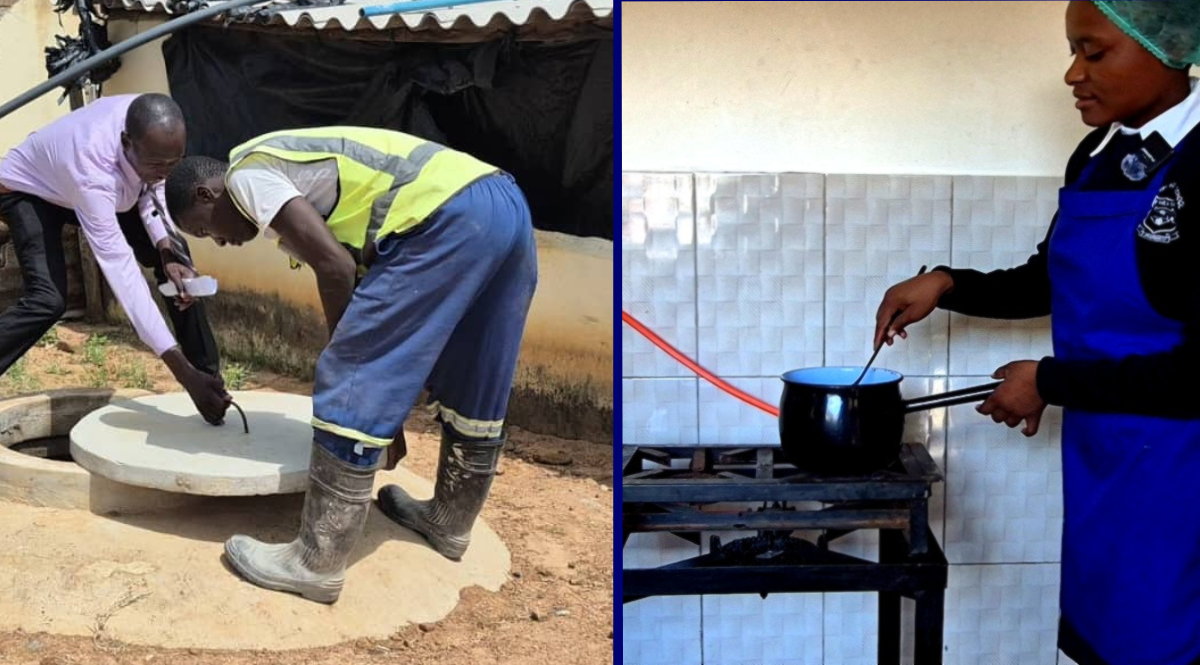
With the introduction of biogas powered by animal waste, the school has eased pressure on firewood use while improving cooking conditions in the kitchen.
“Biogas has made a big difference in our daily lives,” Gomorago added. “Cooking is now faster and cleaner, and we no longer struggle with smoke or delays in starting fires. It has really improved our learning environment.”
The biogas project is part of the Transforming Waste to Resources initiative, which promotes the conversion of waste into useful products that support livelihoods and environmental protection. Construction of the biodigester began in November 2024 and was completed in January 2025. Before its introduction, the school relied heavily on firewood and electricity, which placed pressure on both finances and natural resources.
“In terms of benefits, the first is that we have reduced dependence on firewood and electricity for cooking. Previously we used about 12 cords of firewood per term. This term we have used only three, which reflects a major reduction in tree cutting,” said school head, Mr Steven Mutaiwa.
He said the school now operates on a blended cooking system using both biogas and limited firewood, improving overall efficiency in the kitchen. Chifamba High has 764 learners and a staff complement of 35 teachers. The school expects to fully transition to biogas once boarding infrastructure expansion is completed.
“In fact, we have engaged the Environmental Management Agency (EMA) to assist us in lining the waste pipe from the new hostel so that it feeds directly into the biodigester. Our goal is to eliminate firewood use completely and ensure we have gas available whenever needed,” he said.
Beyond the kitchen, the biodigester is also producing biofertiliser, which the school is now using to support its agricultural projects and generate additional value.
“We were informed that the biodigester also produces fertiliser, so we built a collection tank for the liquid waste, which is rich in nitrogen. This has now become part of our biofertiliser system,” added Mr Mutaiwa.
The school’s livestock projects, including cattle and piggery, are central to sustaining the system, as animal waste feeds directly into the biodigester, ensuring a continuous gas supply.
“The piggery is designed to feed directly into the biodigester. We now use biogas for cooking and also harvest the liquid waste for our gardens,” he said.
At this point, the school-based innovation begins to extend beyond institutional operations into a wider community system. The same waste-to-resource thinking that powers the school is now being replicated in surrounding villages, where women are turning waste into income and environmental solutions.
Engineer Brian Simbarashe Nyakasaka, Provincial Rural Electrification Manager for the Rural Electrification Agency (REA) in Mashonaland Central, said the biodigester forms part of a wider clean energy strategy targeting rural institutions.
“The system was designed to efficiently convert organic waste into energy while reducing reliance on firewood and electricity,” he said.
He added that the broader national goal is to expand access to clean cooking solutions in rural areas by 2030 through solar, grid electricity, and biogas technologies.
“The biodigester at Chifamba School is 13 cubic metres and was installed by REA in collaboration with Chinhoyi University of Technology and the University of Zimbabwe, with support from the European Union and other partners,” he said.
“We are promoting clean cooking so that rural institutions and households gradually move away from firewood towards modern energy systems.”
Chinhoyi University of Technology is also conducting research on expanding biogas applications, including the use of digesters for tobacco curing, which could significantly reduce deforestation linked to curing practices.
REA has so far installed more than 20 institutional biogas digesters in schools and hospitals, ranging from 25 to 100 cubic metres. Five are in hospitals, while the rest are in schools where animal and organic waste is used as feedstock.
The agency is also promoting household-level biogas adoption as part of its broader clean energy rollout.
Building on this institutional model, the waste-to-resource approach has now expanded into Guruve communities, where women are actively transforming waste into income-generating products.
Over 200 women have been trained across Guruve wards to convert both organic and inorganic waste into usable and sellable materials.
One of them, Gogo Rumbidzai Magwaza from Ward 5, Nyangavi, said the initiative has changed both household incomes and the local environment.
“We are a group of 25 women working on income-generating projects. Our goal is to address financial challenges at household level. We collect waste and repurpose it into products we can sell,” she said.
The women produce door mats from old clothes, bags from discarded wool, hats from plastic waste, and decorative bowls made from melted plastics.
“We now see waste differently. What used to be rubbish is now a source of income,” she added.
Knowledge Chikanya from the Guruve Rural District Council directorate said the initiative has also reduced environmental risks in the area.
“We used to lose livestock after they ingested plastic waste. That problem has significantly reduced, although I do not have exact figures,” said Chikanya.
Professor Kudakwashe Chitindingu, Principal Investigator for the Transforming Waste-to-Resources project at Chinhoyi University of Technology, said the programme links energy, environment, and livelihoods through practical community systems.
“At the school, we introduced biogas to reduce reliance on firewood and support cooking needs for learners. Across Guruve’s 24 wards, we trained community champions, especially women, to convert inorganic waste into usable products,” he said.
“We trained 240 women, ten in each ward, who now serve as knowledge multipliers. We have also trained male champions in organic waste valorisation, including conversion into animal feed.”
The Guruve initiative shows how waste, once seen as a burden, can become a driver of energy access, income generation, and environmental protection when systems are connected from schools to households.
Rather than operating as separate interventions, the school biogas system and community recycling networks now form a single rural circular economy. Firewood demand is declining at institutional level, plastic pollution is being reduced at community level, and new income streams are emerging for women and households.
The Guruve initiative also reflects broader regional discussions under the Capacitating One Health in Eastern and Southern Africa (COHESA) programme, which emphasises integrated approaches to human, animal, and environmental health. While COHESA focuses on building regional frameworks and networks, the Guruve biogas and waste-to-resource model demonstrates how these principles are being translated into practical community action, from clean energy adoption in schools to waste recycling initiatives led by women.
In this way, Guruve’s waste-to-resource model demonstrates a practical One Health pathway where human health, environmental protection, and local economies are strengthened together through shared infrastructure, shared knowledge, and shared responsibility.