By Kuda Pembere in Buhera
On a humid Wednesday afternoon, inside a classroom at St Michael’s Mambo Primary School in Buhera, 12-year-old Nenyasha Mukomba carefully holds a tablet handed to her by one of her teachers.
A Grade Five pupil, Nenyasha was born with a congenital limb difference that left her without fingers on her right hand. For the first four years of her primary education, writing classwork was a difficult and often exhausting task.
Although her parents owned smartphones, the introduction of computers and tablets at school has made a significant difference to how she approaches her schoolwork.
A new way to learn
Her experience began to change in January this year, when she started Grade Five and gained access to digital learning devices provided through a blended learning initiative led by the Ministry of Primary and Secondary Education (MoPSE), in partnership with UNICEF.
The initiative is supported by the United Kingdom Government through the Foreign, Commonwealth and Development Office (FCDO), under the Teacher Effectiveness and Equitable Access for Children (TEACH) programme.
“Computers and tablets ease my school work because they have keys that are easy to press for typing. Before these gadgets came, it was difficult writing classwork with one hand but now the load has been lifted when writing on the computer,” she said.
The devices have not only made completing classwork easier but have also helped her understand lessons and engage more effectively in class.
“I would be tired before the lesson was finished. School felt like a burden, the only time I enjoyed was when we left class for the playgrounds,” she said.
Encouraged by her teachers, Nenyasha’s parents bought her a computer in June, allowing her to continue learning at home. She can now revisit digital learning materials and revise at her own pace.
“I can learn like everyone else. When I type, I do not have to hold a book and write at the same time. I feel happy when my teacher sends my work back and tells me what I did well and where I need to improve,” she said.
Technology transforms classroom learning
In this rural community, where many families depend on subsistence farming and face difficulties meeting school-related costs, access to digital learning was once a distant prospect. Teachers and pupils largely relied on scarce textbooks and conventional classroom instruction.
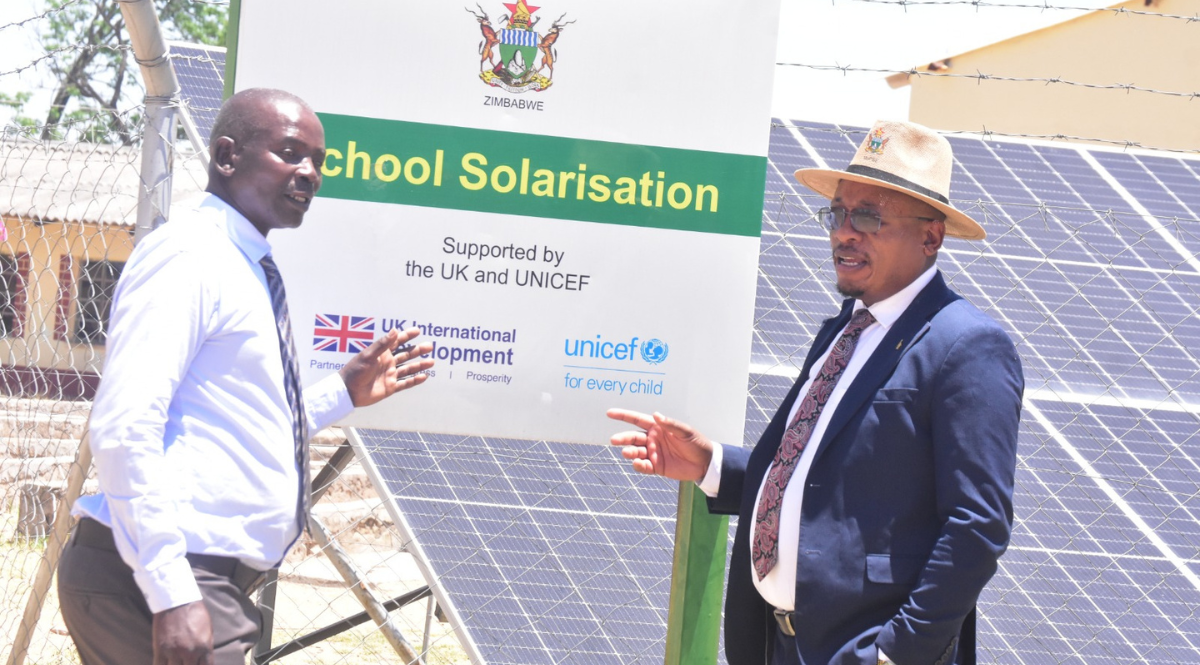
Through the Ministry of Primary and Secondary Education and UNICEF, with support from the UK Government-funded TEACH programme, St Michael’s Mambo received seven projectors, seven laptops and 20 tablets in February. The intervention built on solar power infrastructure installed at the school with UNICEF support in 2023.
For Nenyasha, the technology is removing barriers that previously made classroom activities difficult. This has, Nenyasha says, cleared her path to become a nurse, her dream job of nursing and caring for the ill.
“The projector makes it even better because we have the visuals up on the board. The tablets make it easy for me to solve maths problems. Science experiments are fully explained and demonstrated on the tablet, unlike before when everything was on paper or written on the board,” she said.
For the school’s ICT teacher, Gresham Manyarara, blended learning is changing the way teachers deliver lessons by combining digital resources with face-to-face instruction.
The approach gives educators more ways to explain concepts and support pupils who need additional assistance.
“Children can now learn on their own, they don’t always need my physical presence. I am now working as a facilitator,” he said.
Manyarara uses digital content to make lessons more practical and expose pupils to experiences beyond their immediate surroundings.
“These children are not always exposed to TVs or computers, so this helps them interact with the outside world. It takes our children to a world beyond their surroundings. I can teach about different modes of transport, including those used in Europe, and they can see it,” he explained.
The technology is also allowing him to use his time differently. While pupils work independently on tablets, he can prepare lessons, attend to individual learners or complete other school responsibilities.
Digital tools ease school administration, but challenges remain
The changes are also extending to school administration.
Acting headmaster Denford Basvi recalls the paperwork involved in recording examination results and preparing school reports. Digital tools have made it easier to capture and analyse pupil performance, helping teachers identify progress and areas where additional support is needed.
However, infrastructure remains a challenge.
“Only about four classrooms have electricity from the main power line,” Basvi said.
The school has responded by extending solar connections to about five classrooms, building on its existing solar installation.
Security measures, including burglar bars and the employment of two security guards, have also been introduced to protect the equipment.
Teachers have had to adapt to the new approach. Some initially struggled to move away from familiar paper-based teaching methods. Basvi subsequently tasked Manyarara and another teacher with stronger computer skills to help colleagues become more confident in using laptops and projectors.
Government pushes to expand digital learning
The initiative is part of the Government’s wider efforts to expand digital learning, particularly in rural and underserved communities.
Taungana Ndoro, the Ministry of Primary and Secondary Education’s director of communications and advocacy, said the distribution of learning devices was part of a whole-of-government and whole-of-society approach aimed at ensuring that no school, teacher or pupil was left behind.
“The digital learning platforms that we have available in our schools have to do with the whole of government approach. You see that we noticed as the government of Zimbabwe obviously that there is infrastructure that is needed in terms of making sure that we have got digital learning platforms in our rural and remote areas.
“So together with the Ministry of Energy and Power Development you can see there is electricity at this school but to add on to that we have also had partners who have come on board such as the FCDO and UNICEF to also provide solar farms so that we’ve got backup electricity,” he said.
Ndoro said access to electricity was essential for the effective use of digital learning platforms.
“Digital platforms only go live when there is electricity. So we’ve made sure that most of our schools, if not all by now, have got electricity whether it’s on the grid, whether it’s a solar farm or it’s a generator.
“Once they have got that infrastructure they are now able to connect to electricity and then have connectivity. So working together with the Ministry of ICT we have managed to get at least about over 8,000 Starlink kits that have been distributed throughout Zimbabwe particularly to needy schools. We have about 12,000 schools.
“The other schools, the 3500, most of them are well resourced and they already had their own internet connectivity but those that don’t have we have given them Starlink kits. So once there is internet at the school then the digital learning platforms are now available,” Ndoro said.
He added that the Ministry, working with UNICEF, had developed an e-learning platform known as Learning Passport Zimbabwe, which provides teaching and learning materials from Early Childhood Education and Care (ECEC) through to Form Six.
“We also have negotiations with the Ministry of ICT such that whoever opens that platform, the Learning Passport Zimbabwe, the data charges are very, very minimal such that pupils and teachers are able to read and study online wherever they are.
“We are impressed by what is happening here at St Michael’s Mambo here in the Buhera district. We are happy that they have shown that digital learning platforms are not only for the able bodied.
“You could see, you did see that there were actually also people with disabilities who were also taking part in the digital learning platforms. It is a strategy which we have used as the Ministry of Primary and Secondary Education to ensure that we increase the pass rates, to ensure that we leave no one behind, to ensure that we continue to provide quality education for all Zimbabweans,” he said.
For Nenyasha, the impact of the technology is already evident. Tasks that once left her exhausted are now easier to complete, giving her more time to concentrate on learning.
With a computer at home and access to digital resources at school, she can participate in lessons and complete assignments with greater independence.