By Marceline Mukwamba
In Zimbabwe, conversations about termination of pregnancy often begin and end with moral discomfort. Too often, they are shaped by silence, fear, misinformation and stigma rather than by the law, medical evidence, constitutional values and compassion for survivors. Yet for a woman or girl who becomes pregnant as a result of rape, this is not an abstract debate. It is a deeply personal crisis involving trauma, bodily violation, health risks, legal rights, family pressure, spiritual pain and, in many cases, unbearable uncertainty.
Our values call us to protect life, uphold dignity and care for the vulnerable. But protection of life must include the life, health and dignity of the rape survivor. Compassion must extend to the child survivor, the adolescent survivor, the woman raped by a stranger, the woman abused by a relative, and the married woman violated in her own home. Justice must not require survivors to carry the physical and emotional consequences of sexual violence in silence while society debates their pain from a distance.
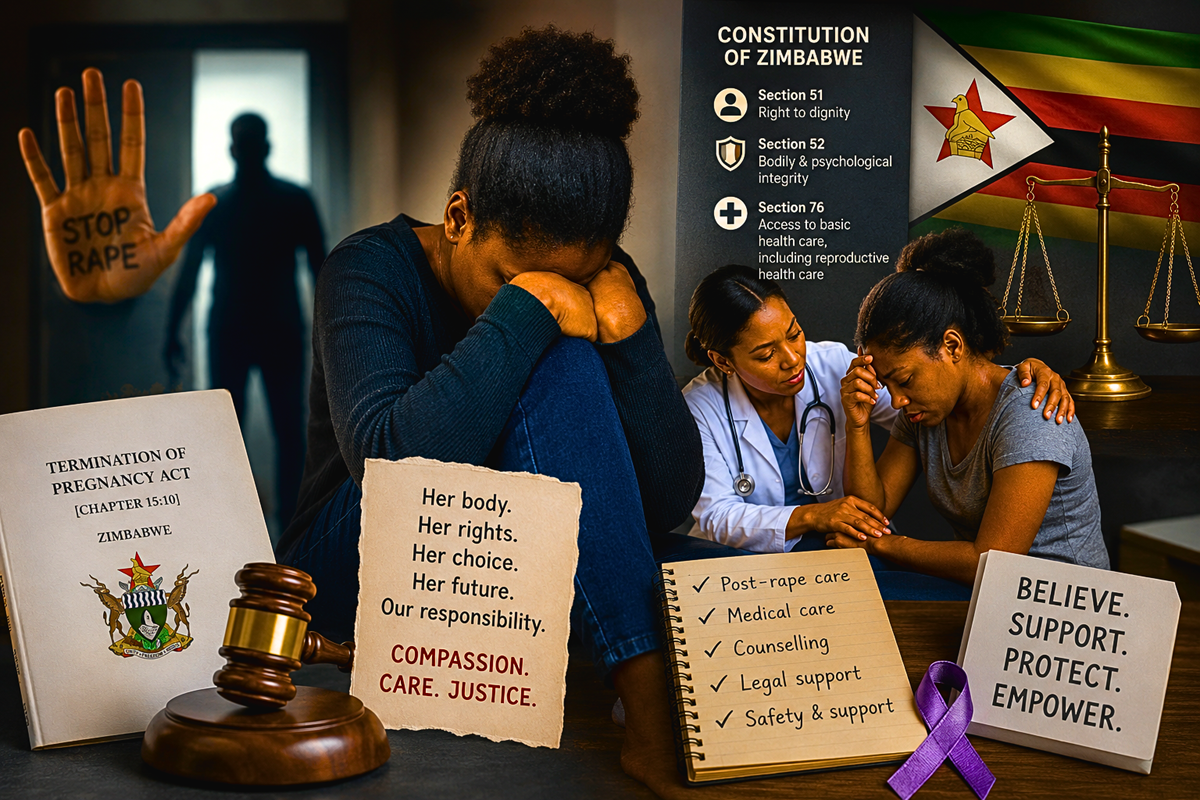
The first misconception that must be corrected is the belief that termination of pregnancy is completely illegal in Zimbabwe. This is not true. Zimbabwe’s Termination of Pregnancy Act [Chapter 15:10] permits termination of pregnancy under specific circumstances. These include where continuing the pregnancy endangers the life of the woman or poses a serious threat of permanent impairment to her physical health; where there is serious risk that the child to be born will suffer from a serious physical or mental defect; and where there is a reasonable possibility that the pregnancy resulted from unlawful intercourse, including rape and incest.
The law also sets out procedures. A lawful termination must generally be performed by a medical practitioner in a designated institution, with written permission from the superintendent of that institution. In rape-related cases, the Act provides for a magistrate’s certificate confirming, on the required legal standard, that a complaint was lodged and that there is a reasonable possibility that the pregnancy resulted from the unlawful intercourse. This means that Zimbabwean law already recognizes that forcing a rape survivor to continue a pregnancy in every circumstance would be unjust and harmful.
The second misconception is that seeking a lawful termination after rape is the same as promoting abortion “on demand.” It is not. In the Zimbabwean legal context, termination of pregnancy after rape is a specific legal pathway created for exceptional circumstances involving sexual violence, trauma and rights violations. It is not a casual decision. It is not an act of recklessness. It is often a painful, urgent and medically significant decision made by a survivor who has already suffered a grave violation.
The third misconception is that the Constitution has nothing to do with this issue. In fact, Zimbabwe’s Constitution protects human dignity, bodily and psychological integrity, and access to basic health-care services, including reproductive health-care services. Section 51 protects the right to dignity. Section 52 protects bodily and psychological integrity, including freedom from violence and the right, subject to the Constitution, to make decisions concerning reproduction. Section 76 protects access to basic health-care services, including reproductive health care, and prohibits refusal of emergency medical treatment.
These constitutional provisions matter because rape is not only a criminal offence; it is an assault on dignity, bodily integrity, mental health and personal security. When a rape-related pregnancy occurs, the State, the health system, families, churches and communities all have a responsibility to respond in ways that protect the survivor rather than deepen her trauma.
From a health perspective, time matters. Early presentation after rape allows survivors to receive urgent post-rape care, including HIV post-exposure prophylaxis, emergency contraception, and treatment for sexually transmitted infections, forensic documentation, psychosocial support and safety planning. When pregnancy has already occurred, early health-seeking allows proper assessment, counselling, and gestational dating through ultrasound, legal guidance and referral through the lawful pathway where the survivor qualifies.
Early access to safe, lawful termination of rape-related pregnancy can reduce physical and psychological harm. Medically, procedures are generally safer when conducted early, by trained providers, in appropriate health facilities and within the law. The World Health Organization notes that termination of pregnancy, when carried out using a recommended method appropriate to the duration of pregnancy and supported by a trained person, is a simple and extremely safe health procedure. This is why delays caused by stigma, fear, misinformation, unnecessary referrals or administrative bottlenecks can put survivors at greater risk.
Delay can lead to serious consequences. As the pregnancy advances, medical management becomes more complex. Survivors may face increased risk of complications, prolonged psychological distress, suicidal thoughts, family rejection, school dropout, forced marriage, social isolation and unsafe attempts to end the pregnancy outside the health system. Delayed disclosure is especially common among children and adolescents, who may not understand pregnancy, may fear punishment, may be threatened by perpetrators, or may be silenced by relatives seeking to protect family reputation.
Complications associated with delayed or unsafe care may include severe bleeding, infection, sepsis, uterine injury, infertility, chronic pelvic pain, anaemia, psychological trauma and, in the worst cases, death. Delayed care also affects evidence collection in rape cases and can weaken the survivor’s access to justice. When communities tell survivors to “keep quiet,” “wait,” “pray only,” or “settle the matter as a family,” they may unintentionally expose the survivor to greater medical, legal and emotional harm.
A survivor of rape does not need condemnation at the clinic door, whispers in the church pew, or blame from relatives. She needs care, truth, prayer, accurate information, medical support, legal assistance and emotional safety.
The question before us is not whether rape is wrong; all decent people agree that it is very wrong. The harder question is whether, after rape has occurred, we will force the survivor to carry the burden alone. Will we treat a pregnant child as a sinner before we treat her as a victim of abuse? Will we protect the reputation of families more than the health of girls? Will we allow myths about the law to deny survivors services that Parliament and the Constitution already recognize? Will we speak of morality while ignoring the suffering of the person in front of us?
We all have an important role to play. We can encourage early reporting after rape. We can support survivors to access health care within 72 hours where possible. We can preach against sexual violence and child abuse. We can discourage harmful “family settlements” that protect perpetrators. We can accompany survivors without shaming them. We can help communities understand that lawful medical care after rape is not a rejection of faith; it is an act of protection, mercy and justice.
Health workers also need clarity and confidence. Some survivors are delayed because providers themselves are unsure of the law, fear being accused of wrongdoing, or impose personal beliefs without offering lawful referral. Conscientious beliefs must not become a barrier to emergency care, accurate information or referral. Survivors should be informed of their rights and options in a respectful, non-coercive and survivor-centred manner. The role of the health system is not to punish but to treat, document, counsel, refer and protect.
A lawful right delayed until the pregnancy is advanced can become a right denied. Survivors should not be moved from office to office while their health risk increases. Families, too, must change their response, when a girl discloses rape or pregnancy, the first response should not be anger, blame or concealment. It should be safety, medical care and reporting. Parents and guardians must understand that early care can prevent HIV, prevent pregnancy if within the emergency contraception window, treat infections, preserve forensic evidence, and provide emotional support. Where pregnancy has already occurred, early care allows lawful options to be explored before risks increase.
A society that values life must value the life of the survivor. A society that values children must not force children into motherhood after abuse. A society that values family must confront the relatives, neighbours, teachers, religious leaders and intimate partners who violate women and girls.
Termination of pregnancy after rape is not merely a legal issue. It is a public health issue, a justice issue, a constitutional issue, a child protection issue and a moral issue. The moral test is not how loudly we condemn termination of pregnancy in general terms. The moral test is how faithfully we protect a survivor whose body has already been violated, whose future is at risk, and whose dignity the law commands us to respect.