By Michael Gwarisa
Zimbabwe has enacted sweeping amendments to the Medical Services Act that will require private hospitals to provide life-saving emergency treatment to critically ill patients regardless of their ability to pay, marking one of the country’s most significant health law reforms in recent years.
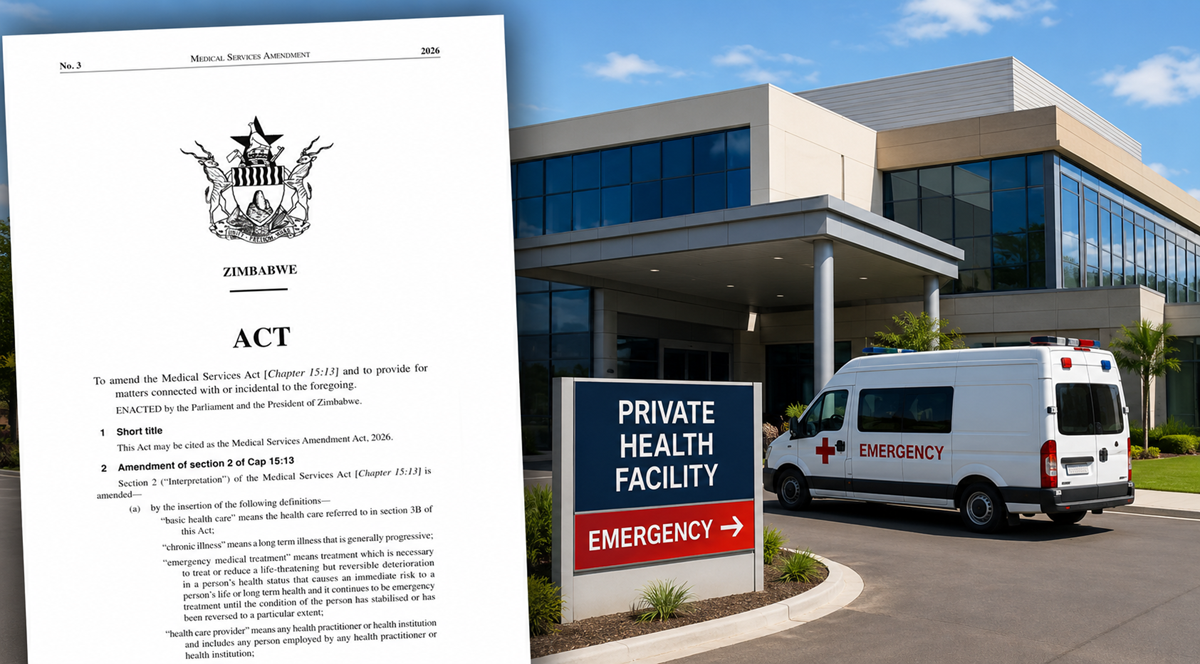
The Medical Services Amendment Act, 2026, gazetted this week after being signed into law by President Emmerson Mnangagwa, places a legal obligation on private health institutions to admit and stabilise patients facing life-threatening medical emergencies for at least 48 hours before they can be transferred to another facility.
The law seeks to strengthen access to emergency healthcare by preventing private hospitals from refusing treatment to patients solely because they cannot afford upfront medical fees, a practice that has long drawn criticism from health rights advocates.
According to the Act, emergency medical treatment is defined as treatment necessary to address a life-threatening but reversible deterioration in a person’s health that poses an immediate risk to life or long-term health. Such treatment remains an emergency until the patient has been stabilised or their condition has improved to a reasonable extent.
The amendment also expands the role of private healthcare providers during national emergencies. It empowers the Minister of Health and Child Care to request private hospitals to provide specialist medical services for patients referred from public health institutions during public health crises or disasters.
To facilitate this arrangement, the Act allows the government, patients or other responsible parties to enter into cost-recovery agreements with private health institutions for services rendered.
The legislation introduces stiff penalties for non-compliance. Heads of private health institutions, or health practitioners acting without the authority of their institutions, who refuse to admit patients requiring emergency treatment could face a fine of up to Level 8, imprisonment for up to one year, or both.
Government spokesperson Nick Mangwana said the amendment fundamentally changes how emergency medical care will be handled in Zimbabwe.
“Private health institutions must now admit any patient with a life-threatening emergency for at least 48 hours to stabilise them before transfer, even if the patient cannot afford care,” Mangwana said in a post on X.
He added that the Minister of Health may also request private facilities to provide specialist services for public emergency patients during public crises, while cost-recovery agreements can be negotiated with either the State or patients.
“Heads of private institutions (or practitioners acting without authority) who refuse such emergency admission face fines up to Level 8 or imprisonment up to one year. This provision effectively bars private facilities from turning away critical emergency cases based solely on inability to pay,” Mangwana said.
Beyond emergency treatment, the Medical Services Amendment Act introduces new legal definitions, including basic health care, chronic illness, emergency medical treatment, and health care provider, providing greater clarity on the scope of healthcare services and responsibilities under Zimbabwean law.