By Kuda Pembere
In a move aimed at strengthening livestock policy through data-driven insights, Zimbabwe’s Ministry of Lands, Agriculture, Fisheries, Water and Rural Development has received a consignment of ICT equipment to enhance the collection and management of feed and fodder data nationwide.
The equipment — including six laptops, two desktop computers, and a printer — was purchased by the African Union Inter-African Bureau for Animal Resources (AU-IBAR) through its Resilient African Feed and Fodder Systems (RAFFS) project. It was handed over to the Zimbabwe Feed and Fodder Multistakeholder Platform (MSP), which then presented it to the Agriculture Ministry.
The initiative is part of efforts to build a comprehensive data ecosystem that will support evidence-based decision-making and policy formulation in the livestock sector. The Ministry plans to leverage its vast network of agricultural extension officers to collect and manage data from across the country.
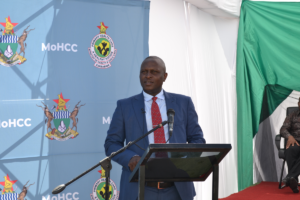
Permanent Secretary in the Ministry, Professor Obert Jiri, underscored the importance of accurate data for effective policy development in the livestock sector.
Let’s ensure that we have good, accurate, and accessible data that can eventually inform livestock policy,” said Prof. Jiri. “Feed and fodder are crucial for us. The data collection process will be a litmus test for the upcoming leap season.”
He emphasized that data-driven solutions are critical to preventing livestock losses due to inadequate feed.
“We don’t want to see livestock dying because of feed shortages. It’s almost like watching our own children die of hunger while we are present. We must ensure that the data we collect and the policies we implement help us care for our livestock. No animal should die under our watch,” he added.
Prof. Jiri further stated that the upcoming leap season would be a benchmark for assessing progress.
“This next season will be the test. We’ll count how many cattle die. If any do, then we must reflect and ask: where did we go wrong? That is the true measure of whether our strategies are working.”
Chairperson of the Zimbabwe Feed and Fodder MSP, Dr. Nathaniel Makoni, said the donation was prompted by a lack of reliable national data on feed and fodder.
“As a multi-stakeholder platform, we continue to recognize that our current data ecosystem is inadequate and fails to inform policy and decision-making effectively,” said Dr. Makoni. “We are grateful to AU-IBAR for donating the equipment. The Ministry has provided space at the Ministry’s farm building, where a dedicated team will manage and operate the data system moving forward.”
Zimbabwe is among six African countries implementing the RAFFS project. The others include Kenya, Somalia, Nigeria, Uganda, and Cameroon.
MSP Secretary Dr. Jacob Gusha explained that these countries have already undertaken a process known as feed balancing — a data-driven approach to evaluating feed supply and demand.
“The other five countries have completed what they call feed balancing,” Dr. Gusha said. “Cameroon, Uganda, Nigeria, Somalia, and Kenya have all done it. We now aim to do the same in Zimbabwe using software developed by the International Livestock Research Institute (ILRI).”
The ILRI software uses satellite imagery to analyze land usage, distinguishing between grazing land and arable land, and identifies crops under cultivation.
“This helps us determine the harvesting index and estimate the biomass yield from those crops,” Gusha said. “That data is essential to making informed decisions about livestock feeding and fodder management.”