By Kuda Pembere
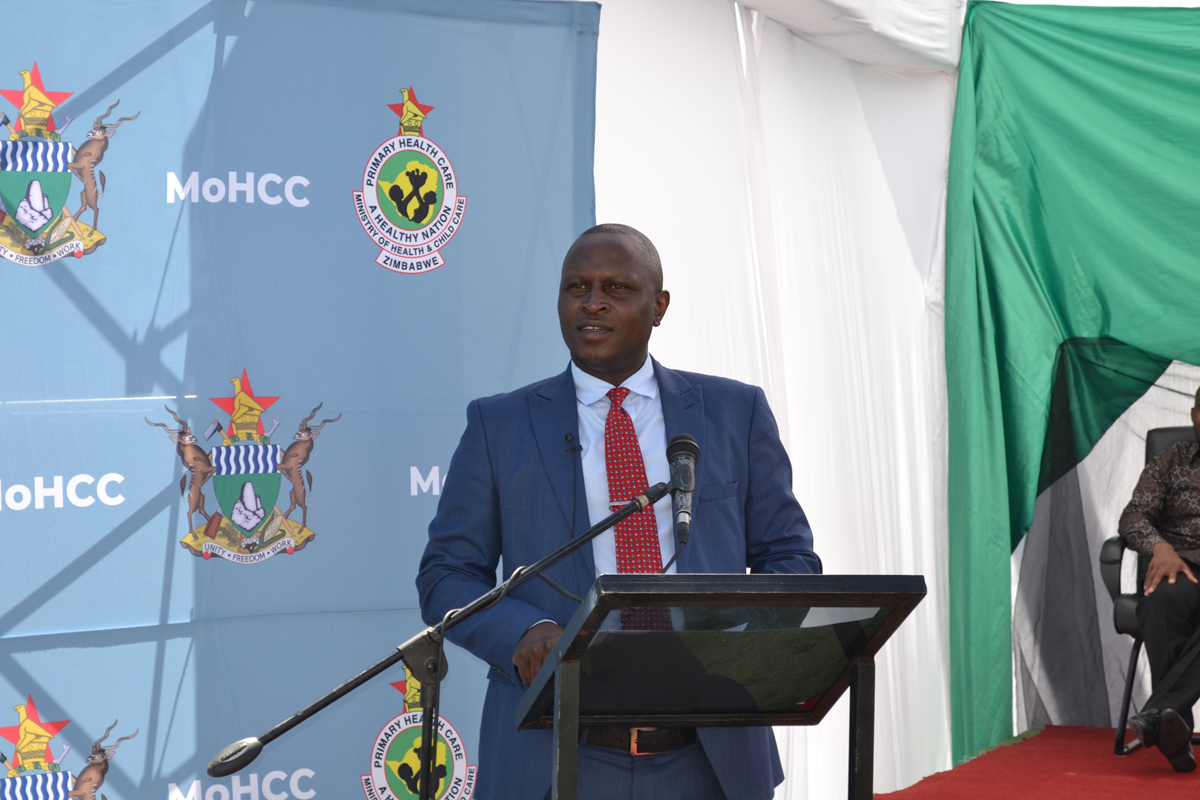
As Zimbabwe moves to operationalize the National Public Health Institute (NPHI), Health and Child Care Minister Dr. Douglas Mombeshora has appointed Dr. Raiva Simbi as the Ministry’s Coordinator. Dr Mombeshora made the announcement came after a courtesy call by a joint delegation from the European Union (EU) and the World Health Organization (WHO).
“We have just had a meeting, a very important meeting, which was a courtesy call, but bringing good news to us as a country and also as Minister of Health and Child Care. Issues at stake were concerning the establishment of a National Public Health Institute,” Dr. Mombeshora told journalists.
“And we’ve got WHO here and members from the European Union. But the good news is that members of the European Union have put up funds to help us establish the NPHI to the tune of about 4.3 million euros (US$5,038,096). So, we have also appointed a coordinator from the Ministry and that’s Dr. Raiva Simbi. He will be working with this team to make sure that we operationalize the National Public Health Institute.”
Anna Cichocka, Head of Cooperation for the EU Delegation to Zimbabwe, said the appointment of a coordinator marked an important step forward.
“We are very happy to start this collaboration. We see already concrete actions being taken by the Ministry of Health and hard work put in by our partners WHO,” she said. “So, we have already a coordinator that was appointed for the role. And we are looking forward now to starting the work on regulatory matters but also exchanges and putting all the basis to effectively establish NPHI in Zimbabwe. And then collaborate more widely in Africa and between Europe and 10 other African countries, making a network of those public health institutes effective.”
The four-year EU-funded initiative, implemented with WHO, is designed to strengthen Zimbabwe’s ability to prevent, detect, and respond to public health threats
“So, this is an initiative actually funded by the European Union and Team Europe, which means also its member states. So, the idea is really to work together to put our strengths together to be even more effective,” Cichocka added.
WHO Zimbabwe Representative Dr. Desta Tiruneh said the NPHI would consolidate the country’s fragmented health functions.
“It’s going to be a very important addition to what is already in existence in the country. There are institutions that are operating in different functions of the National Public Health Institute. But the new National Public Health Institute will help us to coordinate these efforts that are actually fragmented into one awesome coordinated action that will strengthen the country’s preparedness for any health emergencies and dealing with also major health challenges,” he said.
He confirmed WHO would serve as a technical partner in the Institute’s operationalization.
“And it will be an important addition also to the international community as part of the global health security. Zimbabwe’s preparedness will add to the preparedness of a better situation for the global community. So, we look forward,” he said.
“WHO will be providing the technical backstopping in this process. And we are very glad to be part of this. It’s part of our role. And we are very grateful also to the European Union for availing substantial resources that will help us to achieve this by bringing the different partners and working with the Ministry of Health. And we look forward for this institution’s establishment and function.”
Guided by the Africa CDC Framework and aligned with the Global Gateway Health Package launched at the 6th EU–AU Summit, the NPHI will focus on science, evidence generation, and data-driven policy advice rather than direct service delivery.
This support forms part of the Team Europe Initiative on National Public Health Institutes in Sub-Saharan Africa, contributing to Sustainable Development Goal 3 on Good Health and Well-being. Once operational, the NPHI is expected to become a cornerstone of evidence-based decision-making, improving the health and well-being of Zimbabweans.
Key priorities include developing a national strategy and roadmap for public health, strengthening disease surveillance and research—particularly on non-communicable diseases such as hypertension and diabetes—improving digital health literacy, and reducing the public health skills gap. Zimbabwe is also expected to expand its participation in regional and international health networks.
The establishment process will be consultative, bringing together the Ministry of Health and Child Care, universities, research institutes, and other health partners, while fostering collaboration with African and European public health institutes that have successfully implemented similar models.