By Michael Gwarisa in Goromonzi
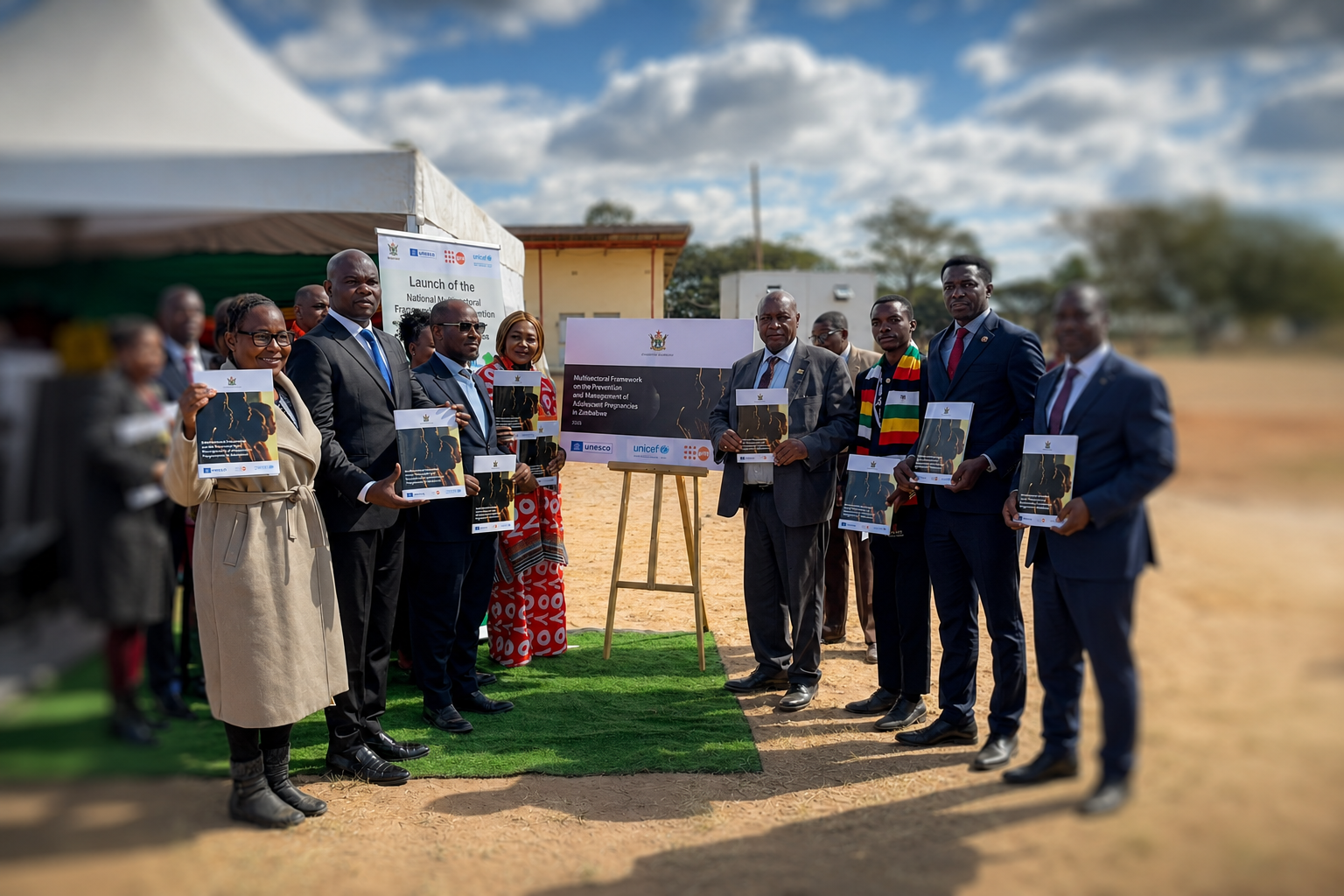
A hush settled over the grounds of Goromonzi High School on a chilly Monday morning in the third week of June 2026 as government officials, development partners, traditional leaders, health workers and students gathered to launch Zimbabwe’s National Multi-Sectoral Framework for the Prevention and Management of Adolescent Pregnancies.
Amid the crowd, a young woman slowly made her way to the podium.
Wearing a flowing green floral dress, she walked carefully, pausing every few steps to steady herself. At times, she rested both hands on her heavily pregnant belly before moving on.
She was neither a government official nor a guest of honour.
She was a teenager carrying not only a child, but a story she never imagined she would one day share before a national audience.
As she reached the microphone, the gathering fell silent.
Then she began to speak.
“This is something I would not wish on anyone,” said 19-year-old Melody Musina, (not her real name), her voice shaking as she fought back tears.
She stopped.
For several moments she struggled to continue, breathing heavily as emotion overwhelmed her. The microphone captured every pause as she wiped away tears before gathering herself again.
When she finally spoke, her words were simple, but they carried the weight of painful experience.
She said peer pressure, silence and a lack of guidance had led to her pregnancy. What started as trying to fit in with friends had changed the course of her life, interrupting her education and the future she had imagined.
“I fell pregnant because of peer pressure. I lost my footing. Now my school life has been affected,” she said.
Her testimony quickly became the defining moment of an event focused on a crisis that government and its partners say can no longer be ignored.
A national crisis in numbers
The framework was launched against the backdrop of a sharp rise in adolescent pregnancies across Zimbabwe.
According to findings from the 2023 National Assessment on Adolescent Pregnancies, the prevalence of adolescent pregnancy increased from 9 percent in 2016 to 22 percent in 2023, representing a 144 percent increase.
Between 2019 and 2023, more than 358,000 pregnancies were recorded among adolescents aged between 10 and 19 years. Adolescents now account for 21 percent of antenatal bookings at public health facilities.
The assessment also found that young women under the age of 24 contribute about a quarter of all maternal deaths, underscoring the serious health risks associated with early pregnancy.
Health experts say the problem is driven by a combination of poverty, peer pressure, sexual violence, child marriage, school dropouts, harmful social norms and limited access to sexual and reproductive health services.
Government says crisis demands united response
Launching the framework, Minister of Public Service, Labour and Social Welfare Edgar Moyo said the occasion marked far more than the unveiling of another policy document.
“As we officially launch the multi-sectoral framework on the prevention and management of adolescent pregnancies in Zimbabwe, this event signifies not merely the launch of a framework but the beginning of a renewed national commitment to address one of the most pressing public health, social and development challenges confronting our nation,” he said.
Moyo said adolescent pregnancy is rooted in interconnected social and economic challenges that no single institution can address alone.
He warned that the consequences stretch well beyond the individual girls affected.
“When adolescents are denied opportunities, when they leave school prematurely, when they become trapped in cycles of poverty and vulnerability, the consequences extend far beyond individual households,” he said.
“It affects educational attainment, labour productivity, health outcomes, social cohesion and intergenerational poverty.”
He urged the country to view investment in adolescents not as an expense, but as an investment in Zimbabwe’s future.
“Protecting adolescents is not merely a social obligation. It is a strategic investment in human capital and sustainable development,” he said.
Assessment exposes the drivers
Permanent Secretary in the Ministry of Public Service, Labour and Social Welfare Pfungwa Kunaka said the framework was informed by a nationwide assessment carried out through a collaborative process involving government ministries, United Nations agencies and research institutions.
The assessment examined the scale of adolescent pregnancy, the factors driving it, its consequences and weaknesses in existing response systems.
“The findings made it very clear that as a country we are facing a serious problem of adolescent pregnancies, and it is really a pressing public health and developmental challenge,” said Kunaka.
He identified limited access to sexual and reproductive health services, sexual violence, exploitation, child marriage and gaps in comprehensive sexuality education as some of the main drivers.
Kunaka said the framework adopts a whole-of-government and whole-of-society approach, bringing together ten interconnected pillars that include child protection, adolescent-friendly health services, life skills education, economic empowerment and stronger governance systems.
“At the heart of the framework lies a theory of change which recognises that adolescent pregnancy is a symptom of failures across multiple systems and no single institution can solve the challenge in isolation,” he said.
UNFPA calls for community ownership
Representing the United Nations system, UNFPA Zimbabwe Country Representative Miranda Tabifor described adolescent pregnancy as a complex challenge that requires urgent, coordinated action.
She said the framework complements existing national youth development strategies while strengthening efforts to safeguard adolescents.
“The launch today represents not just a policy framework, it is a strategic shift towards national ownership and coordinated action,” she said.
Tabifor said the statistics presented in the national assessment represent far more than numbers.
“For the United Nations, we see these as interrupted dreams. Even when a dream is interrupted, there remains a pathway to recovery and renewed opportunity,” she said.
She added that community-led initiatives such as the Not In My Village campaign would strengthen accountability and improve protection for young people at community level.
From policy to practice
The framework will be rolled out through coordinated structures across government ministries, with support from development partners and pooled financing mechanisms.
Moyo said initiatives such as the Health Resilience Fund are already helping expand investments in maternal, newborn and adolescent health services.
The fund is coordinated by the Ministry of Health and Child Care with support from development partners, including the European Union, Ireland, the United Kingdom and Gavi, the Vaccine Alliance.
The moment that stayed with everyone
Although the launch featured speeches outlining policies, strategies and implementation plans, it was Melody’s testimony that lingered long after the formal proceedings ended.
Her story gave a human face to the statistics, reminding delegates that behind every number is a young person whose future has been altered.
As she walked away from the podium, still wiping away tears, the hall remained quiet.
Outside, conversations shifted back to funding, coordination and implementation.
Inside, however, many delegates were still thinking about the young woman in the green floral dress who had found the courage to share the hardest chapter of her life.
Her final words echoed well beyond the ceremony.
“This is something I would not wish on anyone.”
A challenge beyond the launch
The framework now lays the foundation for a coordinated national response to adolescent pregnancy, but its success will ultimately depend on what happens after the speeches end.
For government, development partners and communities, the challenge is whether action will come quickly enough to stop more girls from standing where Melody once stood.
As delegates left Goromonzi, one message remained unmistakable.
Behind every statistic is a girl.